(Password protected)
Design Synthesis for Strategic Vision
One of the most important functions of design within an organization is developing visuals that help people think. Whether it’s charts and graphs to analyze team metrics, prototypes to test out ideas before we develop, or in-depth research summaries that describe user journeys and our application landscape, simple diagrams and drawings are a key component of helping teams make decisions and organize around a shared set of ideas. In most cases, the artifact itself is not important; it is only a tool that helps us to communicate and evaluate different ideas and approaches.
Here are some examples of diagrams that I’ve created at different stages of the design process to synthesize information and align the team.
Research Synthesis for Early Product Discovery
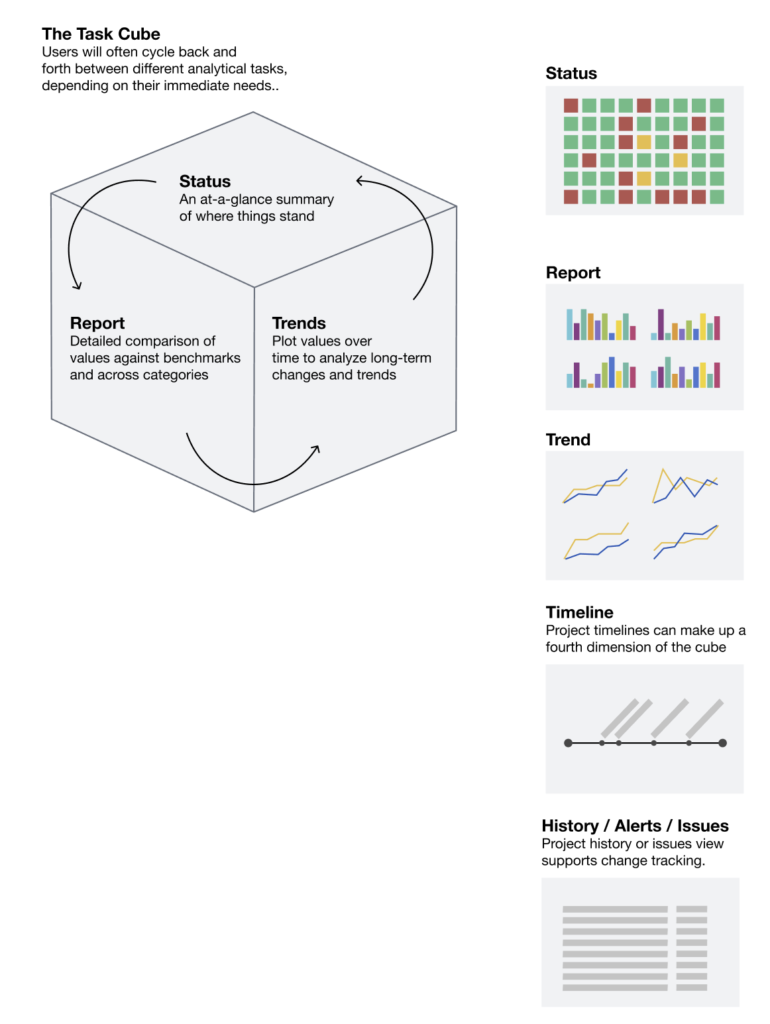
This document summarizes a set of research interviews that I did back in 2020, before starting design for a new application focused on managing a portfolio of studies. I held several calls with internal stakeholders, and 6 externally-facing calls with clients or potential users. That research focused on defining the basic needs of the portfolio manager persona, and also the specific tasks and complexities that the product would need to support.
Persona and Process Maps
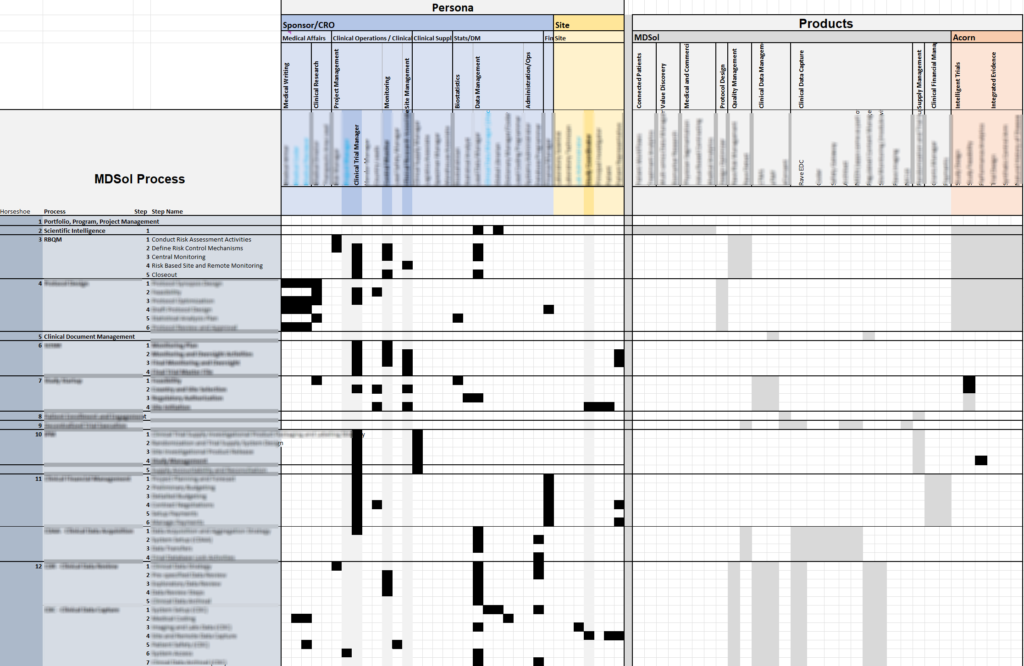
Our company did a platform wide assessment of product and persona coverage as part of integration discussions post-acquisition. I took a massive spreadsheet with 25-30 pages of lookup tables and condensed it down into a single, explorable spreadsheet with collapsing sections to show more detail on demand. Crunching all of this data down into a single view was a fun visualization task, and I like to call the resulting spreadsheet our product Rosetta Stone. It’s too clunky to operate for detailed tasks, but it was very helpful as an overview of the end-to-end clinical trial process, our persona, and how they engage with the products at each step of the way.
Product-level Platform Exchange Maps
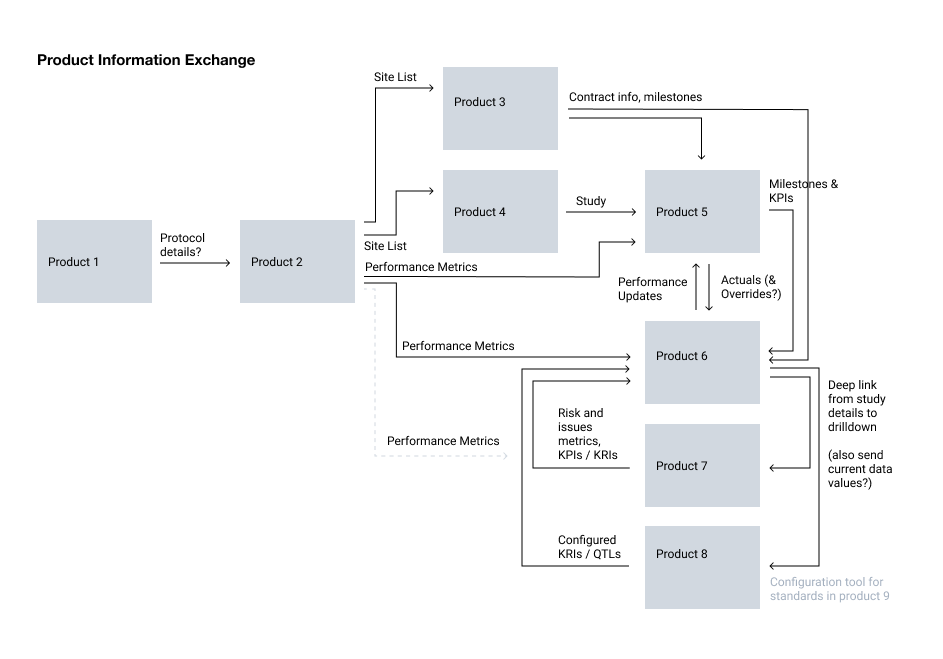
When working in a platform environment, no product is ever building alone. To create multi-product workflows and end-to-end experiences, we also need to map out which product is responsible for which tasks, how information is exchanged within the system (this can be either visible or invisible to the user), work through dependencies, and stage out development at both a function and roadmap level. These large-scale initiatives tend to move slowly, and often require several years of discussion and collaboration to actually build the arrows that connect the boxes.
Designing Cross-Product Modules
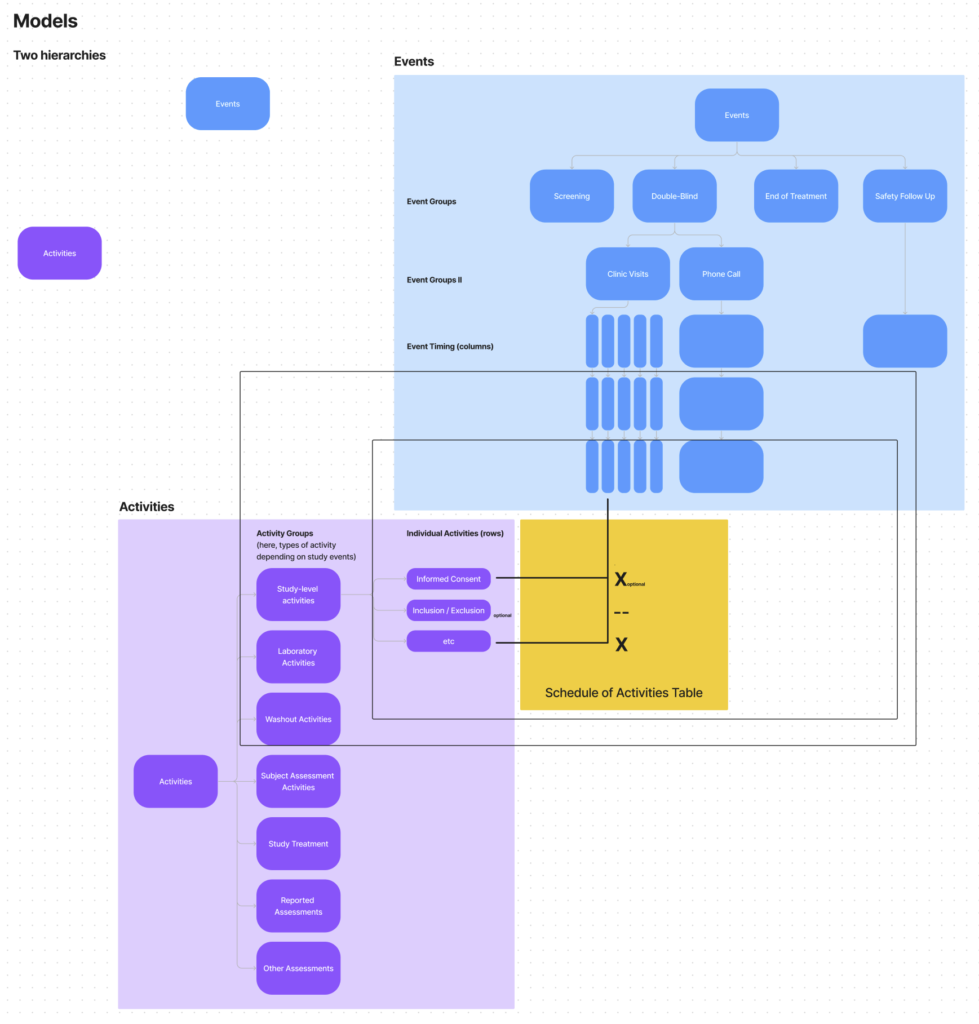
Many tasks and information types span multiple products within our platform. As part of integrating with the design system for the broader org, my team does an across-product discovery session before beginning design on a potential shared function. We identify the core functionalities and tasks that are independent, and those and shared between products. When designing and evaluating product-level features, we keep these design use cases in mind, so that the outcome can be contributed back to the central platform design system and component library, to lighten the load for other products. The Schedule of Activities is part of the study protocol for a clinical trial, and it summarizes all activities required to execute the study. As such, it is a key information object used by many products in the platform. The header image is a diagram of the core object structure for the SoA, from a design team discussion on architecture and shared tasks to inform our local product design.
Designing for AI
Sometimes, design research precedes the product cycle, and (hopefully) informs its strategy and direction. Our company has been developing AI technologies for years, but we are, like everyone else, looking to take advantage of the rapidly-expanding capabilities of generative AI in our user workflows. The data science and modeling team are researching the core technologies, and I worked with our leadership to begin discussions about how we choose to use AI. As part of this, I did a survey of recent literature to better understand the core considerations unique to AI, and wrote a report summarizing key themes. I presented this at a company lunch and learn to begin the conversation, and over the coming months will be connecting with individual design teams to understand where they see opportunities to leverage AI to support our users. Unifying these requests across the different product areas will give a more detailed picture of the technologies that would really move the needle. I also presented this work at the UXPA Boston conference in May 2024.